
Cumberland County Arrest and Booking Records
Cumberland County sits in the Sandhills region of North Carolina with Fayetteville as the county seat. The Cumberland County Sheriff's Office and the Clerk of Superior Court are the two primary agencies that maintain public records on arrests, bookings, and criminal proceedings in this area. This page guides you to official sources for Cumberland County recent arrests, including the Sheriff's active inmate lookup, the county courthouse, and the statewide NC eCourts portal. You do not need to provide a reason when requesting public records in North Carolina.
Cumberland County Sheriff and Recent Arrests
The Cumberland County Sheriff's Office is the lead law enforcement agency serving unincorporated Cumberland County and operates the county detention center at 204 Gillespie Street in Fayetteville. The facility is one of the largest county detention centers in North Carolina, spanning 311,000 square feet with a maximum capacity of 884 inmates. Booking records created at intake are public documents under NCGS 132-1, which gives any person the right to inspect records held by government agencies in this state.
Major Tandra Adams serves as Detention Commander and can be reached at (910) 672-5601. The main detention line is (910) 672-5630. Written records requests addressed to the Sheriff's Office are the standard route for obtaining copies of arrest and booking documents that are not available online. Under NCGS 132-1.4, records tied to active criminal investigations are exempt from public disclosure until the investigation concludes. Once a case moves to the courts, the related arrest records generally become available through both the Sheriff and the Clerk of Court.
The Sheriff's Office website is available at ccsonc.org. That site includes contact information, detention policies, and links to inmate-related tools.
The Cumberland County Sheriff's Office website provides details on the Fayetteville detention facility, including its booking process and inmate services.

The Cumberland County detention center on Gillespie Street in Fayetteville processes all bookings for the county and serves as the main source for recent arrest records.
Active Inmate Lookup for Cumberland County Recent Arrests
The Cumberland County Sheriff's Office provides an active inmate lookup tool at ccsonc.org/active-inmate-page. This tool lets you search for people currently in custody at the Fayetteville detention facility. You search by first and last name. Results show the booking date, current charges, bond amount, and upcoming court dates. This is one of the most direct ways to confirm whether someone was recently arrested in Cumberland County and is still being held.
The lookup reflects current custody status in real time. A person released before you search will not appear in active results. Release from the detention center generally occurs between 6 a.m. and 9 p.m. Visitation is available up to two times per day and up to 14 times per week. Weekday visiting hours run from 8:30 a.m. to 11:30 a.m., 1 to 4:30 p.m., and 6:30 to 9:45 p.m. Weekend hours are 10 a.m. to noon, 1 to 4:30 p.m., and 6:30 to 8:30 p.m.
Note: The active inmate tool shows only people currently in custody. For records of people already released, contact the Sheriff's Office directly or check the eCourts portal for case details.
The Cumberland County active inmate page shows the current status of people detained at the Fayetteville facility, including charges and bond information.

The active inmate search at the Cumberland County Sheriff's Office website lets you look up current detainees by name and view their booking details and charges.
Clerk of Court for Cumberland County Criminal Records
The Cumberland County Clerk of Superior Court is located at 117 Dick Street in Fayetteville and can be reached at (910) 678-2900. The clerk's office holds the official records of every criminal case filed in the county. Those records document what happened after an arrest: the charges a prosecutor filed, scheduled court appearances, plea agreements, trial outcomes, and final sentencing. Court records are distinct from arrest records but are closely tied to them.
Certified copies of criminal case records are available from the clerk for a fee set by state law. In-person visits to the courthouse on Dick Street are the most direct way to obtain certified documents. You can also look up Cumberland County court cases through the North Carolina Courts location page for Cumberland County, which lists courthouse hours, contact information, and links to the statewide case lookup system. Records at the clerk's office are public under NCGS 132-1 unless a specific exemption applies, such as juvenile cases or matters where expungement has been ordered.
The Cumberland County courts page at nccourts.gov provides courthouse location details and links to case lookup tools for criminal matters arising from recent arrests.
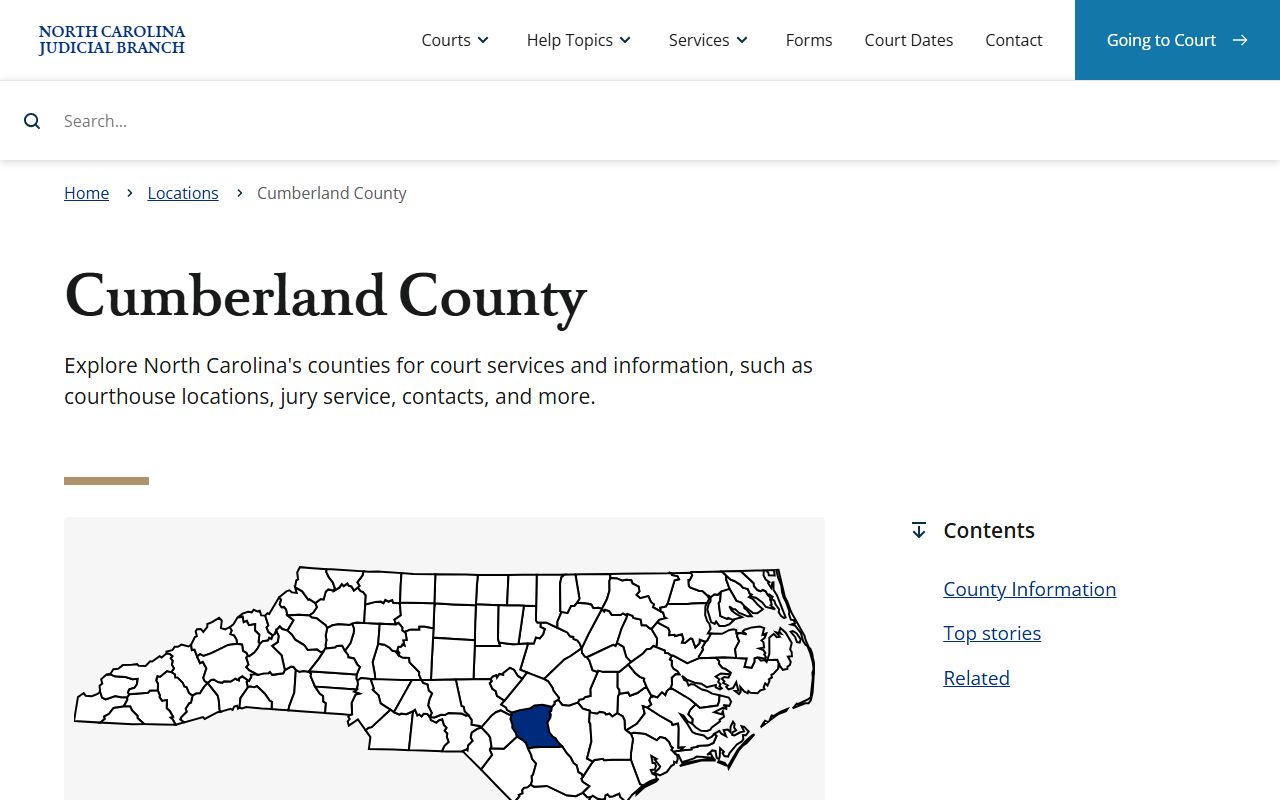
The Cumberland County Clerk of Superior Court on Dick Street in Fayetteville maintains criminal case files and provides certified copies of records tied to arrests and prosecutions.
NC eCourts Portal and Cumberland County Cases
The NC eCourts portal at portal-nc.tylertech.cloud provides statewide online access to court records, including Cumberland County cases. You can search by party name, case number, or attorney. The portal shows case status, scheduled hearings, and party information without a trip to the courthouse. It is free to use for basic case lookups.
Cumberland County recent arrests that result in criminal charges will appear in the eCourts system once the case is filed by a prosecutor. Tracking a case from booking through disposition is straightforward using the portal. You can check the current stage of a case, see whether a hearing is coming up, and confirm whether charges were amended or dismissed. The portal is one of the most efficient tools for following a Cumberland County criminal case over time.
The eCourts system covers cases from courts statewide. Fayetteville cases, cases from other Cumberland County cities, and cases originating from arrests by any agency operating in the county are all indexed in the same system.
What Cumberland County Arrest Records Contain
A standard Cumberland County arrest record includes the full name of the person arrested, their date of birth, the date and location of the arrest, the arresting officer and agency, and the charges. The booking record created at the Fayetteville detention facility adds bond information and the first scheduled court date. These documents are created at the time of intake and are typically among the first public records available after a recent arrest.
Arrest records are not proof of guilt. A Cumberland County recent arrest only shows that law enforcement had probable cause. Charges can later be reduced, dropped, or result in acquittal at trial. The court record, available through the Clerk of Court or the eCourts portal, shows the full outcome of the case. Checking both the arrest record and the court record gives the most complete picture of any given situation.
Note: Cumberland County processes bookings from the Sheriff's Office, Fayetteville Police Department, and other agencies operating in the county. All of those bookings flow through the same detention facility on Gillespie Street.
Fayetteville Arrests and the County Detention System
Fayetteville is the largest city in Cumberland County and home to a substantial share of all arrests processed through the county detention system. The Fayetteville Police Department operates independently from the Sheriff but books arrested individuals into the same county facility. That means recent arrests made by Fayetteville officers will appear in the same detention records as arrests made by county deputies.
Fort Liberty, formerly known as Fort Bragg, is one of the largest military installations in the United States and sits in Cumberland County. Military personnel arrested on post are typically processed through military justice channels, but off-post arrests of service members are handled by civilian law enforcement and go through the county system. Cumberland County's large military population adds to the range of circumstances that appear in local arrest records.
North Carolina Public Records Law and Arrest Data
NCGS 132-1 is the foundation of public records access in North Carolina. It defines public records broadly to include any document, report, or data made or received by a government agency in the course of official business. Arrest and booking records fall squarely within that definition. Any person may request them. There is no requirement to explain why you want the records.
NCGS 132-1.4 creates a targeted exemption for criminal investigation records. If a Cumberland County recent arrest is part of an ongoing investigation, details of that investigation are protected from public release until the investigation ends. This exemption is narrow. It covers the investigation itself, not the fact of the arrest or the charges. NCGS 132-6 gives you the right to inspect and receive copies of records that are not exempt. Agencies must respond within a reasonable time and may charge only actual costs for reproduction.
- NCGS 132-1 -- General public records access for all persons
- NCGS 132-1.4 -- Exemption for active criminal investigation files
- NCGS 132-6 -- Right to inspect and copy public records
- Juvenile records are sealed and not available to the public
- Expunged records are removed from public access once the order is granted
Cumberland County Recent Arrests and Court Outcomes
Following a Cumberland County arrest from the booking stage through final court resolution takes time. The detention record captures the moment of intake. The eCourts portal shows the case as prosecutors file charges and hearings are scheduled. The Clerk of Court at 117 Dick Street provides certified copies of case documents and final dispositions once the case concludes.
For very recent arrests, the most current data is usually at the detention facility. Booking records are created at intake and update quickly. Court records take longer because they depend on formal action by prosecutors and judges. Using the active inmate lookup at ccsonc.org alongside the eCourts portal at portal-nc.tylertech.cloud gives the most complete view of any Cumberland County case from arrest through case closure.